
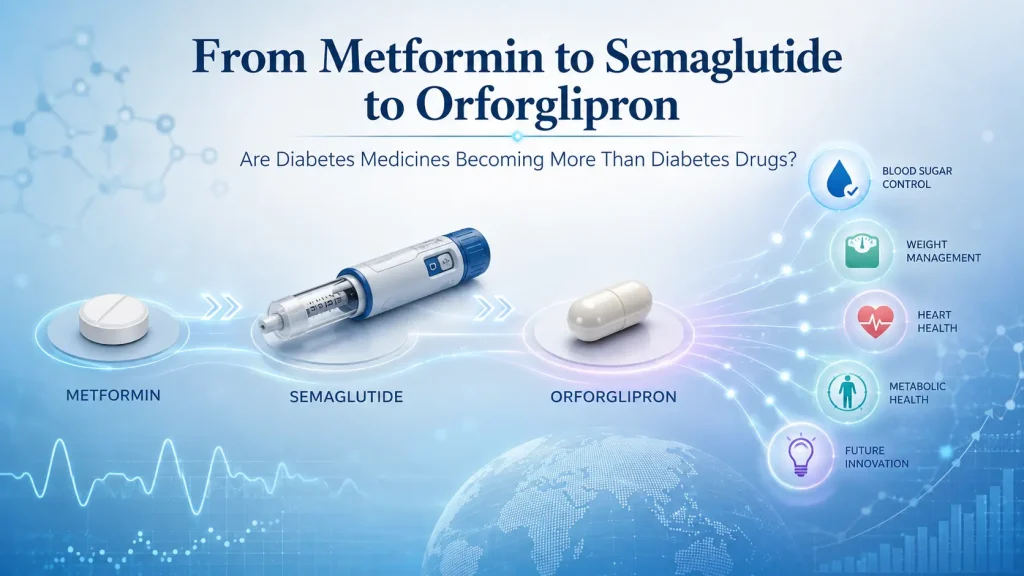
An extension of “Semaglutide and Metformin: Six Decades Apart, but Is the Newer Medicine Really Better?”
A pharmacist’s perspective on the next evolution of diabetes and metabolic therapy
In my previous article, “Semaglutide and Metformin: Six Decades Apart, but Is the Newer Medicine Really Better?”, I explored how two medicines separated by more than 60 years of pharmaceutical development can both remain valuable in modern diabetes care.
The conclusion was deliberately simple:
newer does not automatically mean better, and semaglutide is not simply a modern replacement for metformin.
But pharmaceutical science has already added another interesting medicine to this discussion.
Orforglipron.
At first glance, orforglipron may appear to be simply another GLP-1 medicine joining an increasingly crowded field. But scientifically, it represents something more interesting.
Metformin showed that a relatively simple oral molecule could modify glucose metabolism.
Semaglutide showed that scientists could redesign a naturally occurring peptide hormone and transform it into a powerful medicine affecting glucose, appetite, body weight and cardiometabolic health.
Orforglipron now attempts to combine two attractive characteristics:
the convenience of a conventional small-molecule tablet with the biological power of GLP-1 receptor activation.
And this raises a broader question.
Are we simply developing better drugs for lowering blood glucose?
Or are the medicines that originated in diabetes treatment gradually becoming tools for treating the much larger spectrum of metabolic disease?
Three Medicines, Three Different Eras of Pharmaceutical Science
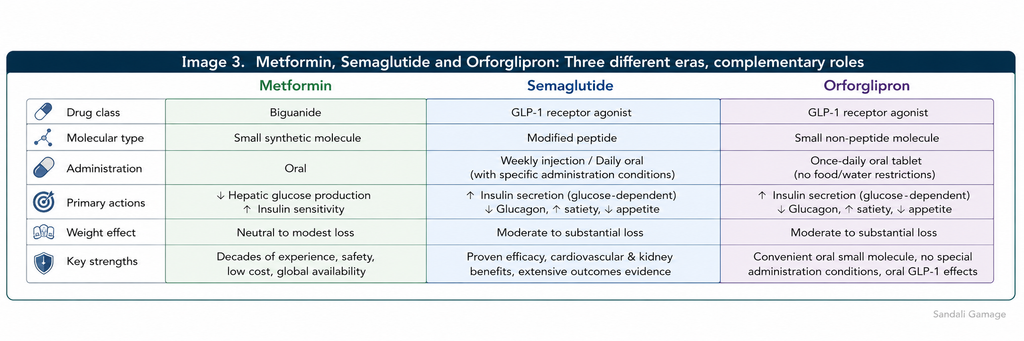
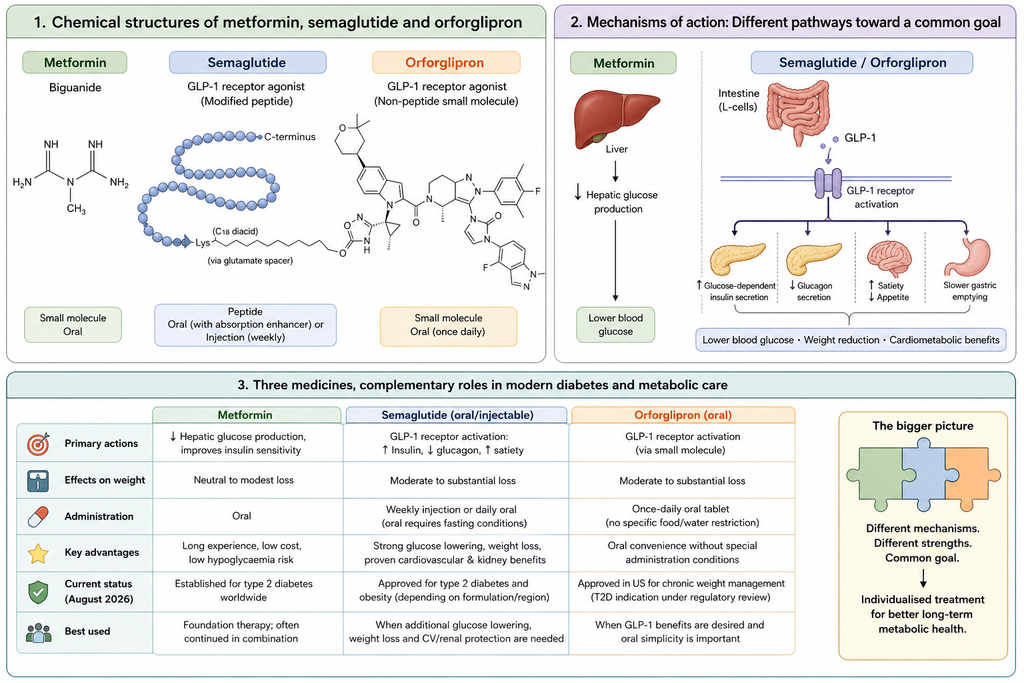
Metformin, semaglutide and orforglipron provide an interesting snapshot of how drug development has evolved.
| Characteristic | Metformin | Semaglutide | Orforglipron |
|---|---|---|---|
| Drug class | Biguanide | GLP-1 receptor agonist | GLP-1 receptor agonist |
| Molecular type | Small synthetic molecule | Modified peptide | Small non-peptide molecule |
| Major action | Reduces excessive hepatic glucose production and improves metabolic regulation | Activates GLP-1 receptors | Activates GLP-1 receptors |
| Administration | Oral | Weekly injection or daily oral formulations | Once-daily oral tablet |
| Appetite effect | Limited | Strong | Strong |
| Weight effect | Neutral to modest reduction | Moderate to substantial reduction | Moderate to substantial reduction |
| Special oral dosing issue | Generally none | Oral semaglutide requires formulation-specific administration instructions | No specific fasting or post-dose food/water timing restriction |
| Evidence history | More than six decades | Extensive diabetes, obesity, cardiovascular and kidney evidence | Newer; evidence base still developing |
| Current US position | Established diabetes medicine | Approved for several diabetes/weight-related indications depending on product | Approved for chronic weight management; type 2 diabetes indication submitted for regulatory review |
This table also reveals something important.
Although semaglutide and orforglipron act on the same receptor system, chemically they are profoundly different.
Semaglutide is an engineered peptide.
Orforglipron is not.
That distinction may be one of the most important technological developments in the next generation of metabolic medicines.
Why Was Making a GLP-1 Medicine Into a Tablet So Difficult?
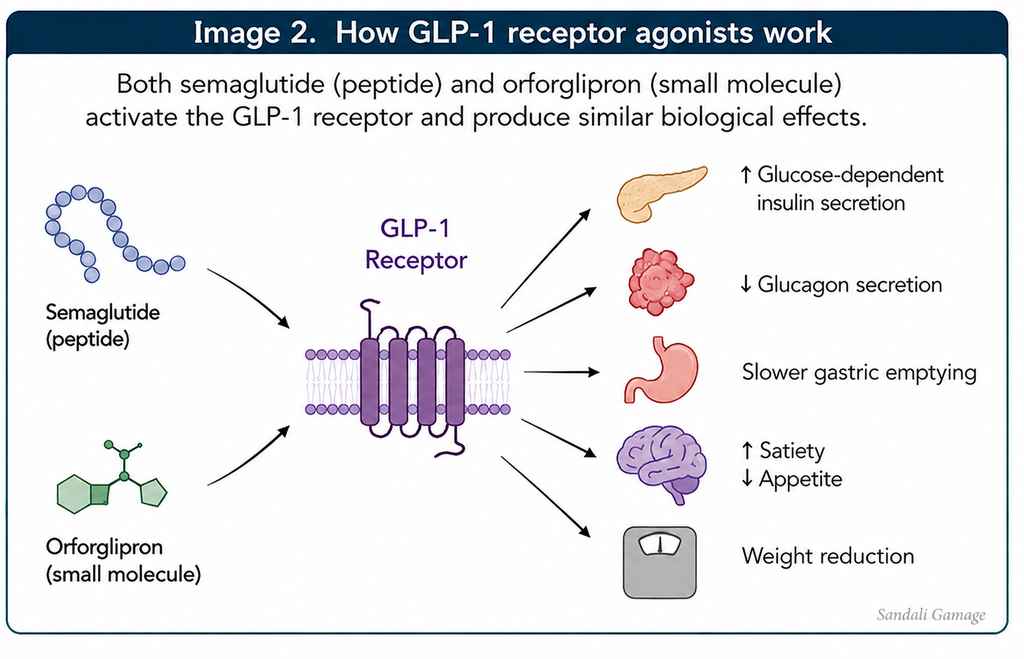
GLP-1 is a naturally occurring hormone released from the intestine after eating.
Among its actions, GLP-1 helps:
- increase glucose-dependent insulin secretion,
- reduce inappropriate glucagon secretion,
- regulate appetite and satiety,
- reduce energy intake,
- and influence gastrointestinal function.
The therapeutic potential of GLP-1 has therefore been obvious for many years.
The problem was delivering it.
Peptides are poor conventional oral medicines. Digestive enzymes can break them down, and their large molecular structures pass poorly through the gastrointestinal lining.
This is why many peptide medicines are administered by injection.
Oral semaglutide represented a major pharmaceutical achievement because scientists found a way around this problem.
The semaglutide molecule is co-formulated with an absorption enhancer known as SNAC — salcaprozate sodium. SNAC helps create a local environment that facilitates absorption of the peptide through the stomach.
That technology made oral GLP-1 therapy possible.
But it also created practical limitations.
Oral semaglutide absorption is sensitive to the conditions under which it is taken, so patients must follow product-specific instructions regarding food, water and the timing of other oral medicines.
Orforglipron approaches the problem from the opposite direction.
Instead of asking:
How can we force a large peptide through the gastrointestinal tract?
pharmaceutical scientists asked:
Can we design a much smaller non-peptide molecule capable of activating the same GLP-1 receptor?
The answer appears to be yes.
What Exactly Is Orforglipron?
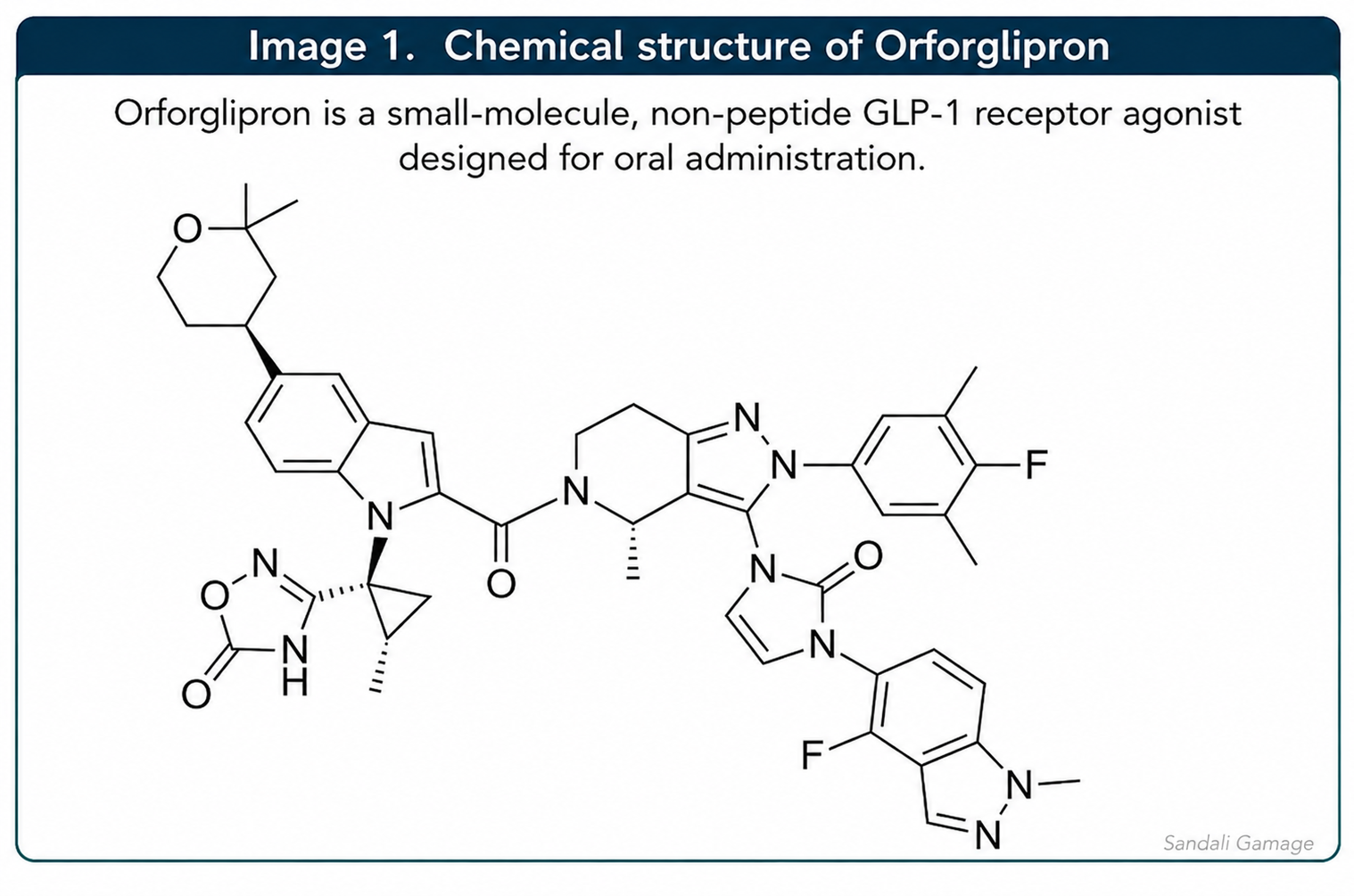
Orforglipron is a small-molecule, non-peptide GLP-1 receptor agonist.
Despite being structurally unrelated to the natural GLP-1 peptide, it can bind to and activate the GLP-1 receptor.
The downstream clinical consequences resemble those expected from GLP-1 receptor stimulation:
Orforglipron → GLP-1 receptor activation → increased glucose-dependent insulin secretion + reduced glucagon + increased satiety + reduced energy intake → improved glycaemia and weight reduction
But because orforglipron is a small non-peptide molecule, it does not require the same absorption-enhancing technology used with oral semaglutide.
It can therefore be administered once daily without the specific fasting and post-dose food or water restrictions associated with oral semaglutide.
This may sound like a minor practical improvement.
It may not be.
For a medicine intended to be taken every day for many years, simplicity matters.
A treatment can be pharmacologically excellent but clinically disappointing if patients find it difficult to incorporate into everyday life.
Orforglipron Has Already Crossed an Important Regulatory Milestone
Orforglipron is sometimes still described as an “experimental diabetes pill.”
That description is now incomplete.
On April 1, 2026, the US Food and Drug Administration approved orforglipron under the brand name Foundayo for long-term weight management in adults with obesity, or adults with overweight who have at least one weight-related comorbidity, together with reduced-calorie diet and increased physical activity.
However, an important distinction must be made.
As of August 2026, its type 2 diabetes indication remains under regulatory review. Eli Lilly reported that applications for type 2 diabetes had been submitted in the United States, European Union and Japan.
Therefore, describing orforglipron as already approved specifically for diabetes in the United States would be premature.
Its diabetes evidence, however, is already substantial.
And one trial is particularly interesting.
Orforglipron Versus Oral Semaglutide: We Now Have a Head-to-Head Trial
The phase 3 ACHIEVE-3 trial, published in The Lancet in 2026, directly compared once-daily oral orforglipron with oral semaglutide in 1,698 adults with type 2 diabetes inadequately controlled with metformin.
This last part is worth emphasizing:
the participants were already receiving metformin.
That makes ACHIEVE-3 especially relevant to the discussion started in my previous article.
It was not really a trial asking:
Should we abandon old metformin and use a new medicine instead?
It asked a much more clinically realistic question:
What can be added when metformin alone is no longer enough?
Participants received once-daily orforglipron or oral semaglutide for 52 weeks.
Starting from an average HbA1c of approximately 8.3%, the primary treatment-regimen analysis reported mean HbA1c reductions of:
- 1.91 percentage points with the higher orforglipron dose, compared with
- 1.47 percentage points with oral semaglutide 14 mg.
The study met its non-inferiority objective and subsequently demonstrated superiority for HbA1c reduction across the prespecified comparisons.
These are impressive results.
But they should be interpreted carefully.
Does This Mean Orforglipron Is Better Than Semaglutide?
Not necessarily.
This is exactly where headlines can become misleading.
ACHIEVE-3 compared orforglipron with oral semaglutide at diabetes doses of 7 mg and 14 mg.
It did not compare orforglipron against every formulation or dose of semaglutide.
For example, it should not be interpreted as demonstrating superiority over weekly high-dose semaglutide used for obesity, nor over the newer 25-mg oral semaglutide formulation approved for weight management.
Different doses, formulations, populations and indications cannot simply be placed side-by-side as though they came from one enormous clinical trial.
There is another detail worth mentioning.
The orforglipron phase 3 programme originally used capsule doses including 12 mg and 36 mg. The subsequently marketed tablet formulation has different numerical strengths because the formulations are bioequivalent: the 36-mg investigational capsule corresponds approximately to the current 17.2-mg tablet.
Therefore, dose numbers from older clinical-trial reports should not automatically be confused with current marketed tablet strengths.
More Powerful Does Not Automatically Mean Easier to Tolerate
The ACHIEVE-3 findings also provide an important reminder about evaluating new medicines.
A medicine should not be judged only by the size of its HbA1c reduction.
Gastrointestinal adverse events were more frequent with orforglipron than with oral semaglutide in the trial.
Approximately 58–59% of participants receiving the studied orforglipron doses experienced gastrointestinal events compared with approximately 37–45% receiving oral semaglutide.
Treatment discontinuation because of adverse effects was also higher with orforglipron, and increases in pulse rate were greater. Most gastrointestinal events were mild or moderate, but these differences remain clinically relevant.
The currently approved orforglipron prescribing information contains precautions familiar from the broader GLP-1 receptor agonist class, including gastrointestinal reactions, pancreatitis, gallbladder disease, dehydration-related acute kidney injury and hypoglycaemia particularly when used with medicines such as insulin or sulfonylureas.
It also carries a boxed warning regarding potential thyroid C-cell tumour risk and is contraindicated in individuals with certain relevant personal or family histories.
So again:
new pharmaceutical technology does not eliminate pharmacological risk.
What About Semaglutide? Its Major Advantage May Now Be Something Other Than Novelty
Semaglutide is no longer the newest member of this story.
But being slightly older now gives it an important advantage:
evidence maturity.
Semaglutide has accumulated extensive clinical-outcome data extending beyond glucose lowering and weight loss.
In the SELECT cardiovascular-outcomes trial, involving 17,604 adults with overweight or obesity and established cardiovascular disease but without diabetes, weekly semaglutide reduced the risk of cardiovascular death, non-fatal myocardial infarction or non-fatal stroke by approximately 20% compared with placebo.
The FLOW trial subsequently demonstrated that, among people with type 2 diabetes and chronic kidney disease, semaglutide reduced the risk of the primary composite kidney outcome by approximately 24% while also producing favourable cardiovascular and mortality outcomes.
This represents an important change in how modern diabetes medicines are evaluated.
Twenty or thirty years ago, a central question was:
How much does the medicine lower glucose?
Today we increasingly ask:
Does it prevent heart attacks?
Does it slow kidney disease?
Does it reduce cardiovascular death?
Does it help manage obesity?
Does it improve long-term cardiometabolic risk?
That is a much higher standard.
Orforglipron has produced encouraging phase 3 cardiometabolic data, but its long-term evidence base is naturally younger than that of semaglutide.
Time matters in pharmacotherapy.
And Yet Metformin Has Not Disappeared
Against these sophisticated new medicines, metformin can look almost technologically primitive.
It is inexpensive.
It is chemically simple.
It does not dramatically suppress appetite.
It does not routinely produce double-digit percentage weight loss.
It does not have the glamour currently surrounding incretin medicines.
Yet none of these facts makes it irrelevant.
Metformin remains an effective glucose-lowering medicine with decades of clinical experience, minimal risk of hypoglycaemia when used alone and enormous familiarity among clinicians worldwide.
The 2026 American Diabetes Association Standards classify metformin as a high-efficacy glucose-lowering therapy, while recognizing semaglutide and other incretin-based therapies among the most powerful options for glucose and weight management. Modern recommendations increasingly select treatment according to cardiovascular disease, kidney disease, heart failure, obesity, hypoglycaemia risk and individual therapeutic goals rather than following one identical sequence for every patient.
This means the role of metformin is changing somewhat.
But changing is not the same as disappearing.
Perhaps ACHIEVE-3 Gives Us the Best Example of the Future
There is an almost symbolic feature of ACHIEVE-3.
Metformin was already there.
The study compared orforglipron and semaglutide on top of metformin therapy.
In other words, one of the most modern diabetes-drug trials did not demonstrate that pharmaceutical innovation requires us to throw away the medicine developed more than six decades ago.
Instead, it demonstrated how different generations of medicines can be combined.
A future patient might therefore receive:
metformin → targeting hepatic glucose metabolism
together with
a GLP-1 receptor agonist → targeting glucose-dependent insulin secretion, glucagon, appetite and energy intake
and, where clinically appropriate,
an SGLT2 inhibitor → contributing additional cardiovascular and kidney protection.
Modern pharmacotherapy increasingly resembles a toolbox rather than a race in which one medicine must defeat all previous medicines.
Are “Diabetes Drugs” Still the Right Name?
This may be the most interesting question of all.
Semaglutide originated in diabetes treatment but is now deeply involved in obesity medicine and cardiovascular risk reduction.
Its kidney benefits have also become clinically important.
Orforglipron has already received its first US approval not for diabetes, but for chronic weight management.
This reflects a broader transformation in medicine.
Type 2 diabetes, obesity, hypertension, cardiovascular disease, fatty liver disease and chronic kidney disease do not exist as completely isolated conditions.
They frequently share overlapping biological mechanisms involving insulin resistance, adipose tissue dysfunction, inflammation, abnormal energy regulation and vascular risk.
Pharmacological research is therefore beginning to move away from treating a single laboratory value toward modifying the wider metabolic environment in which disease develops.
The evolution might be simplified as:
First generation of thinking:
Lower blood glucose.
Modern thinking:
Lower glucose + manage body weight + protect organs + reduce cardiovascular risk + improve long-term metabolic health.
That represents a much more meaningful pharmaceutical advancement than simply producing a stronger glucose-lowering tablet.
Could Orforglipron Change Access to GLP-1 Therapy?
Potentially.
One major limitation of modern incretin medicines has been practical access.
Peptide drugs are more complicated to manufacture than traditional small molecules. Injectable formulations also require devices, supply infrastructure and patient acceptance.
Semaglutide demonstrated that a peptide GLP-1 medicine could become an oral therapy, but sophisticated absorption technology remained necessary.
Orforglipron demonstrates another possibility:
perhaps the biological effect of a peptide hormone can be reproduced using a conventional small molecule.
In principle, small-molecule medicines may offer advantages in manufacturing, transportation and oral administration.
But this should not immediately be translated into the assumption that orforglipron will automatically be inexpensive or universally accessible.
Manufacturing cost and patient price are not the same thing.
Patent protection, regulatory approval, health-system reimbursement, market competition and national purchasing systems will ultimately influence who can actually obtain these medicines.
This issue is particularly important in lower- and middle-income countries.
A medicine cannot transform public health simply by being scientifically impressive.
It must also reach the people who need it.
For Countries Such as Sri Lanka, “Better” Has an Additional Meaning
In resource-conscious health systems, treatment decisions cannot be based exclusively on the greatest percentage reduction in HbA1c or body weight observed in an international clinical trial.
Affordability matters.
Availability matters.
Long-term adherence matters.
The ability of the health system to sustain treatment matters.
A highly effective medicine that a patient can use for only a few months may not necessarily produce a better long-term result than a less dramatic but affordable therapy that can be continued appropriately for years.
This is one reason why medicines such as metformin remain enormously valuable.
At the same time, ignoring advances such as semaglutide and orforglipron simply because they are newer or initially expensive would also be a mistake.
The appropriate objective is not to choose between innovation and affordability.
It is to find ways of making clinically meaningful innovation accessible.
The Real Evolution Is From Glucose Treatment to Metabolic Treatment
The comparison between these three medicines tells a larger story.
Metformin primarily showed us how modifying metabolism could control hyperglycaemia.
Semaglutide showed us that manipulating hormonal signalling could simultaneously influence glucose, appetite, body weight and important clinical outcomes.
Orforglipron demonstrates that sophisticated receptor pharmacology may no longer require a peptide molecule at all.
That evolution can be represented simply:
Metformin
small molecule → metabolic modulation → reduced hepatic glucose output
Semaglutide
engineered peptide → GLP-1 receptor activation → glucose regulation + satiety + weight reduction + established cardiometabolic outcome benefits
Orforglipron
non-peptide small molecule → GLP-1 receptor activation → glucose regulation + satiety + weight reduction, delivered through a comparatively conventional oral small-molecule platform
Each represents a different pharmaceutical solution to metabolic disease.
None makes the others scientifically meaningless.
A Pharmacist’s Perspective
When metformin entered clinical medicine, success largely meant controlling elevated blood glucose without producing excessive hypoglycaemia.
Today, expectations are much greater.
We want diabetes medicines that control glucose while avoiding hypoglycaemia.
We want them to help manage obesity.
We want cardiovascular protection.
We want kidney protection.
We want convenient administration.
We want tolerability.
And ultimately, we want them to be affordable enough for long-term use.
Orforglipron is exciting because it represents another step toward that goal.
But it should not be viewed as “semaglutide 2.0,” just as semaglutide should never have been described as “metformin 2.0.”
And neither should automatically send the older medicine into retirement.
Perhaps the most important lesson from the progression from metformin to semaglutide to orforglipron is that modern diabetes treatment is becoming less about finding a single “best drug.”
It is becoming more about selecting the right combination of pharmacological tools for the biology, risks, circumstances and goals of an individual patient.
The future may therefore not be:
metformin versus semaglutide versus orforglipron.
It may be:
Which medicine—or combination of medicines—provides this patient with the greatest overall health benefit?
And perhaps one day we will stop thinking of medicines such as these simply as “diabetes drugs.”
Because the disease we are increasingly trying to treat is much larger than blood glucose alone.
Important Note
This article is intended for health education and should not be interpreted as individual medical advice. Metformin, semaglutide and orforglipron are prescription medicines with different approved indications, contraindications, adverse effects and monitoring requirements. Regulatory approval, formulations and availability vary between countries.
As of August 2026, orforglipron is approved in the United States for chronic weight management in eligible adults. Its application for treatment of type 2 diabetes has been submitted for regulatory review; this should not be interpreted as approval for that indication. Decisions regarding initiation, discontinuation or modification of any diabetes or weight-management medicine should be made with an appropriately qualified healthcare professional.
References
- Rosenstock J, Yabe D, Cox D, et al. Efficacy and safety of once-daily oral orforglipron compared with oral semaglutide in adults with type 2 diabetes (ACHIEVE-3): a multinational, multicentre, non-inferiority, open-label, randomised, phase 3 trial. Lancet. 2026;407:1147–1160. doi:10.1016/S0140-6736(26)00202-3.
- Rosenstock J, Hsia S, Nevarez Ruiz L, et al. Orforglipron, an Oral Small-Molecule GLP-1 Receptor Agonist, in Early Type 2 Diabetes. New England Journal of Medicine. 2025;393:1065–1076.
- Wharton S, Aronne LJ, Stefanski A, et al. Orforglipron, an Oral Small-Molecule GLP-1 Receptor Agonist for Obesity Treatment. New England Journal of Medicine. 2025;393:1796–1806.
- Ma X, Li YG, Raha S, et al. Pharmacokinetic Bioequivalence of Orforglipron Tablets and Capsules in Healthy Participants With Obesity or Overweight. Diabetes, Obesity and Metabolism. 2026. doi:10.1111/dom.70783.
- US Food and Drug Administration. FDA Approves First New Molecular Entity Under National Priority Voucher Program: Foundayo (orforglipron). April 1, 2026.
- American Diabetes Association Professional Practice Committee. Pharmacologic Approaches to Glycemic Treatment: Standards of Care in Diabetes—2026. Diabetes Care. 2026;49(Suppl 1).
- Lincoff AM, Brown-Frandsen K, Colhoun HM, et al. Semaglutide and Cardiovascular Outcomes in Obesity without Diabetes. New England Journal of Medicine. 2023;389:2221–2232.
- Perkovic V, Tuttle KR, Rossing P, et al. Effects of Semaglutide on Chronic Kidney Disease in Patients with Type 2 Diabetes. New England Journal of Medicine. 2024;391:109–121.
- Sri Lanka College of Endocrinologists. Clinical Practice Guideline: Diabetes 2025. Sri Lanka Journal of Diabetes Endocrinology and Metabolism. 2025;16(2):3–173.