
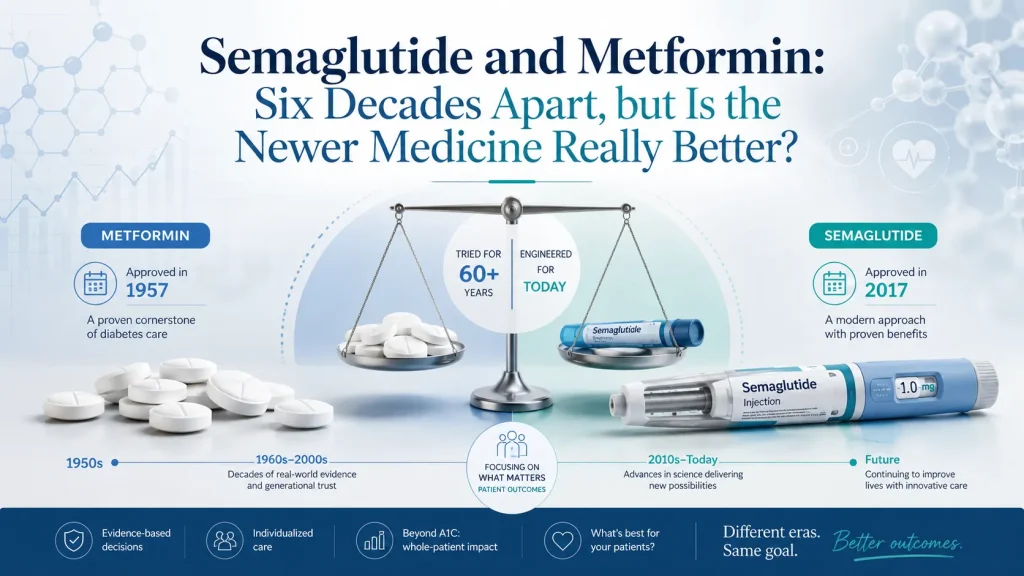
A pharmacist’s perspective on the evolution of diabetes and weight-management therapy
The arrival of semaglutide, particularly in oral tablet form, has attracted remarkable attention among patients, healthcare professionals and the general public. Originally developed for the management of type 2 diabetes mellitus, semaglutide has also demonstrated substantial effects on body weight, leading many to ask an understandable question:
Is semaglutide simply a modern, more advanced replacement for metformin?
The short answer is no.
Semaglutide represents an impressive advance in pharmaceutical science, but it does not belong to a newer “generation” of metformin. The two medicines are structurally unrelated, act through very different biological pathways, and may serve different—but sometimes complementary—roles in the treatment of type 2 diabetes.
Understanding this distinction is particularly important at a time when medicines originally associated with diabetes are increasingly being discussed in the context of weight loss.
From Metformin to Semaglutide: More Than 60 Years of Pharmacological Evolution
Metformin has a fascinating history.
Its origins can be traced to the medicinal plant Galega officinalis, also known as French lilac or goat’s rue, which had historically been used in Europe for symptoms resembling diabetes. The plant contains guanidine-related compounds capable of lowering blood glucose.
Metformin, or dimethylbiguanide, was synthesized during the early twentieth century. However, its importance in diabetes treatment was established largely through the work of French physician Dr Jean Sterne, who reported the successful clinical use of metformin for diabetes in 1957. It subsequently became established in Europe and was introduced in the United States in 1995.
Metformin therefore belongs to an era when pharmacological research largely involved discovering relatively small chemical molecules capable of altering metabolic processes.
Semaglutide emerged through an entirely different scientific pathway.
It developed from research into glucagon-like peptide-1, or GLP-1, a naturally occurring intestinal hormone involved in the regulation of glucose, insulin secretion and appetite. Scientists recognized the therapeutic potential of GLP-1 but faced a major problem: natural GLP-1 is rapidly degraded in the circulation and therefore has a very short biological life.
Researchers at Novo Nordisk in Denmark modified the GLP-1 molecule to produce a more stable, long-acting analogue. The medicinal chemistry underlying once-weekly semaglutide was formally reported in 2015.
Injectable semaglutide was approved in the United States for type 2 diabetes in 2017, while oral semaglutide was approved in September 2019, becoming the first orally administered GLP-1 receptor agonist approved for type 2 diabetes.
The technology has continued to evolve. In December 2025, the United States approved a higher-dose 25-mg oral semaglutide formulation for chronic weight management in eligible adults. However, formulations, doses, indications and availability differ between countries, and a semaglutide tablet intended for diabetes management should not automatically be considered equivalent to one approved specifically for obesity treatment.
Structurally, These Two Medicines Could Hardly Be More Different
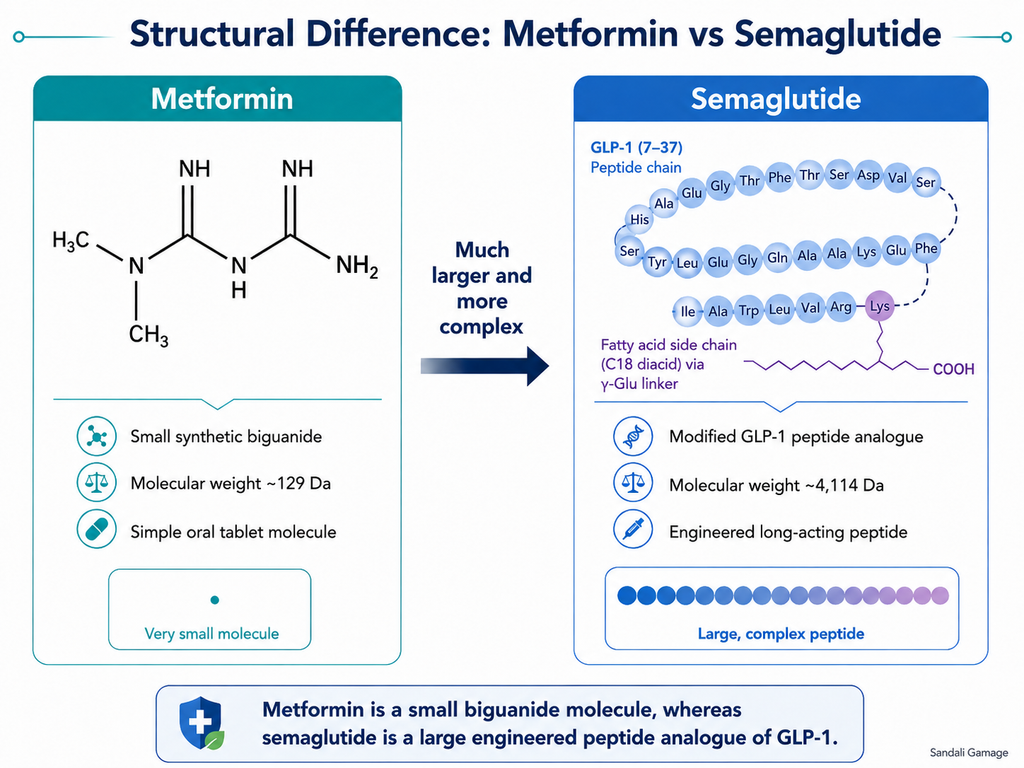
One of the clearest demonstrations of the scientific “generation gap” between metformin and semaglutide can be seen in their molecular structures.
| Characteristic | Metformin | Semaglutide |
|---|---|---|
| Drug class | Biguanide | GLP-1 receptor agonist |
| Molecular type | Small synthetic chemical molecule | Modified peptide |
| Approximate molecular weight | 129 Da as metformin; 165.6 Da as metformin hydrochloride | 4,113.6 Da |
| Structural foundation | Biguanide chemical structure | Analogue of human GLP-1 |
| Main pharmacological target | Metabolic pathways, particularly hepatic glucose production | GLP-1 receptor |
| Major effect on appetite | Limited | Marked reduction in appetite and energy intake |
| Typical effect on weight | Neutral to modest loss | Moderate to substantial loss, depending on dose and indication |
Metformin is a very small, water-soluble molecule. The metformin free base has a molecular weight of approximately 129.16, while the hydrochloride salt commonly used in tablets has a molecular weight of approximately 165.6.
Semaglutide, by comparison, is a large peptide molecule with a molecular weight of approximately 4,113.6. It shares approximately 94% sequence homology with human GLP-1.
Semaglutide has been deliberately engineered. One modification makes the molecule more resistant to degradation by the enzyme dipeptidyl peptidase-4 (DPP-4). Another attaches a C18 fatty diacid side chain, which promotes binding to albumin in the bloodstream.
Albumin binding dramatically slows the elimination of semaglutide, giving the molecule a biological half-life of approximately one week.
This is sophisticated molecular engineering rather than simply modification of an older diabetes tablet.
How Does Metformin Work?
Although metformin has been used for decades, its mechanism is surprisingly complex and is still being investigated.
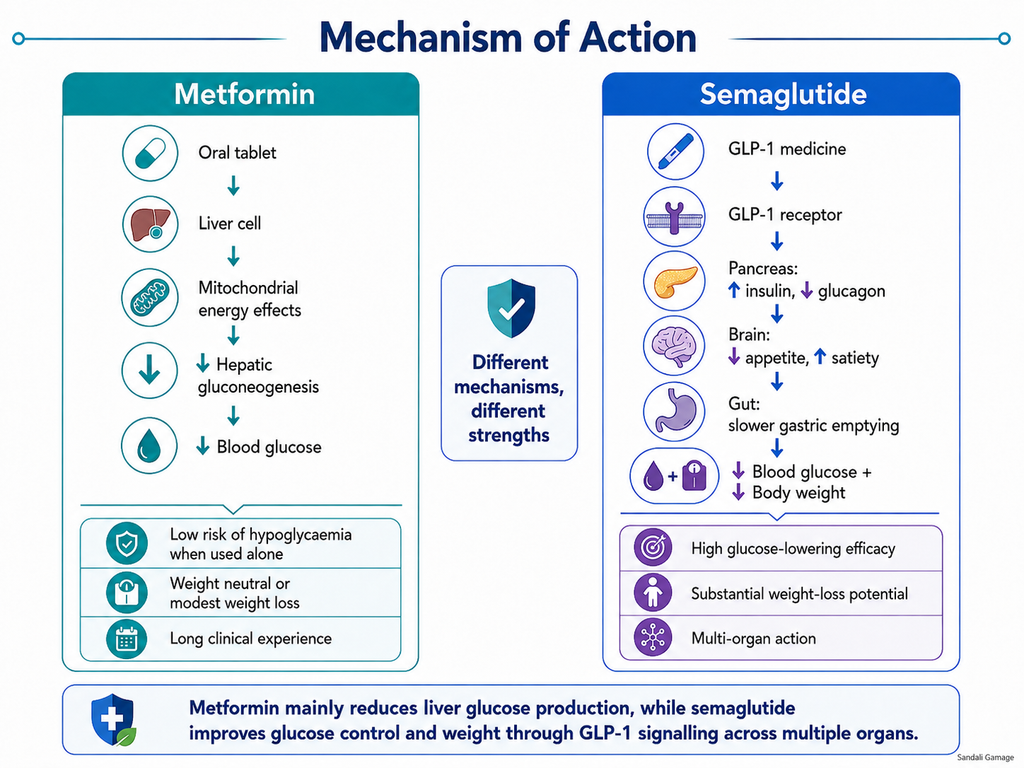
Its most clinically important effect is the reduction of excessive hepatic glucose production.
In type 2 diabetes, the liver may continue producing glucose even when circulating glucose concentrations are already elevated. Metformin helps suppress this inappropriate glucose production, particularly gluconeogenesis.
A simplified pathway can be represented as:
Metformin → hepatocyte → altered mitochondrial energy metabolism → changes in cellular AMP/ATP balance → activation of energy-sensing pathways including AMPK → reduced gluconeogenesis → reduced hepatic glucose output
Metformin has historically been described as an AMP-activated protein kinase (AMPK) activator, but current understanding is more nuanced. Its effects involve mitochondrial metabolism, cellular energy status, AMP-related signalling, the intestine and mechanisms that may be partly independent of AMPK.
The important clinical outcome is straightforward:
the liver releases less glucose into the circulation.
Metformin also improves insulin sensitivity and influences gastrointestinal and metabolic signalling, but it does not strongly stimulate insulin secretion. Consequently, when used alone, it has a very low risk of producing hypoglycaemia.
Semaglutide Works Through an Entirely Different Biological System
Semaglutide behaves like the body’s natural GLP-1 hormone.
After a meal, intestinal cells normally release GLP-1. This hormone communicates with several organs, including the pancreas and brain.
Semaglutide binds to the GLP-1 receptor, which belongs to the G-protein-coupled receptor family.
At pancreatic beta cells, the simplified cellular pathway is:
Semaglutide → GLP-1 receptor → Gs protein → adenylyl cyclase → increased cyclic AMP (cAMP) → activation of PKA and Epac pathways → enhanced glucose-dependent insulin secretion
The phrase glucose-dependent is particularly important.
Semaglutide primarily enhances insulin secretion when blood glucose is elevated. Therefore, semaglutide used alone generally carries a much lower risk of hypoglycaemia than medicines that stimulate insulin irrespective of the glucose concentration. The risk can increase, however, when it is used together with insulin or insulin-secretagogue medicines.
Semaglutide also reduces inappropriate glucagon secretion. Because glucagon encourages the liver to release glucose, reducing glucagon provides another mechanism by which semaglutide improves glycaemic control.
But the effects of semaglutide extend beyond glucose metabolism.
GLP-1 receptors and related neural pathways are involved in appetite regulation. Semaglutide influences brain networks governing hunger, satiety and food intake.
The therapeutic sequence can therefore be simplified as:
Semaglutide → GLP-1 signalling → increased satiety + reduced hunger + reduced energy intake → weight loss
It can also delay gastric emptying, particularly during the early phases of treatment, contributing to post-meal glucose regulation and a sensation of fullness.
This combination of pancreatic, gastrointestinal and central nervous system actions explains why semaglutide produces substantially greater weight reduction than most traditional diabetes medicines.
How Can a Large Peptide Molecule Become a Tablet?
One of the most remarkable pharmaceutical achievements associated with oral semaglutide is not merely the molecule itself—it is getting that molecule through the gastrointestinal tract.
Ordinarily, peptide medicines are poor candidates for tablets. Stomach acid and digestive enzymes can degrade peptides, while their large molecular size prevents efficient passage across the gastrointestinal lining.
This is one reason why medicines such as insulin traditionally require injection.
Oral semaglutide overcame part of this barrier through co-formulation with an absorption enhancer called SNAC—salcaprozate sodium.
SNAC produces a temporary local environment around the tablet that helps protect semaglutide from gastric degradation and facilitates its passage across the stomach epithelium. Studies indicate that oral semaglutide is predominantly absorbed through the stomach rather than the intestine.
This explains another practical characteristic of oral semaglutide: its absorption can be significantly affected by food and other medicines. Depending on the specific product, patients are instructed to take it under carefully defined fasting conditions and to delay eating, drinking or taking other oral medicines for a specified period afterward.
This is pharmaceutical technology that did not exist when metformin entered clinical practice.
Is Semaglutide Better Than Metformin for Diabetes?
The answer depends on what is meant by “better.”
If the question is:
Which medicine has greater glucose-lowering potency?
Semaglutide is generally considered a higher-efficacy glucose-lowering treatment.
The 2026 American Diabetes Association Standards identify semaglutide among the agents with the highest efficacy for glucose lowering as well as weight reduction. GLP-1 receptor agonists added to metformin commonly provide approximately 1 percentage point to 2 percentage points or greater reductions in HbA1c, depending on the drug, baseline HbA1c and population studied.
However, potency is not the only consideration in pharmacotherapy.
Metformin remains:
effective, extensively studied, inexpensive, widely available, associated with minimal hypoglycaemia when used alone, generally weight neutral or modestly weight reducing, and supported by decades of clinical experience.
Importantly for the Sri Lankan context, the Sri Lanka College of Endocrinologists Clinical Practice Guideline: Diabetes 2025 continues to describe metformin as a preferred initial pharmacological agent, particularly in individuals without special considerations, while emphasizing patient-centred selection of therapy. The same guideline recognizes GLP-1 receptor agonists as important options in modern diabetes management.
Modern diabetes care therefore increasingly asks a different question:
What is the most appropriate medicine for this particular patient?
A person with obesity, established cardiovascular disease, chronic kidney disease or a strong need for weight reduction may have reasons for receiving a GLP-1 receptor agonist. Another patient with newly diagnosed uncomplicated type 2 diabetes may achieve excellent control with metformin, lifestyle modification and appropriate monitoring.
Furthermore, semaglutide and metformin are not necessarily competitors.
They are frequently used together.
Is Semaglutide Really Better for Weight Loss?
Here the difference is much clearer.
Metformin can result in modest weight reduction, but it is not primarily an anti-obesity medicine.
In the Diabetes Prevention Program, metformin was associated with approximately a 2% average reduction in body weight during the randomized period, and modest weight reduction was maintained in long-term follow-up.
Semaglutide has demonstrated a substantially greater magnitude of weight loss.
For example, in the STEP 2 trial involving adults with overweight or obesity and type 2 diabetes, once-weekly semaglutide 2.4 mg produced approximately 9.6% mean body-weight reduction after 68 weeks, compared with 3.4% with placebo.
More recently, the OASIS 4 trial evaluated oral semaglutide 25 mg in adults with overweight or obesity without diabetes. Mean body-weight reduction was approximately 13.6% at 64 weeks, compared with approximately 2.2% with placebo.
These figures should not be interpreted as a direct head-to-head comparison with metformin because they arise from different clinical trials involving different patient populations, doses and treatment conditions.
Nevertheless, the overall evidence is convincing:
for clinically meaningful weight reduction, semaglutide is substantially more effective than metformin.
This is also reflected in current diabetes guidelines, which prioritize semaglutide and other high-efficacy incretin-based therapies when substantial weight reduction is an important therapeutic objective.
Does This Represent a “Generation Gap” in Medicines?
In technological terms, yes—but pharmacologically, the phrase requires caution.
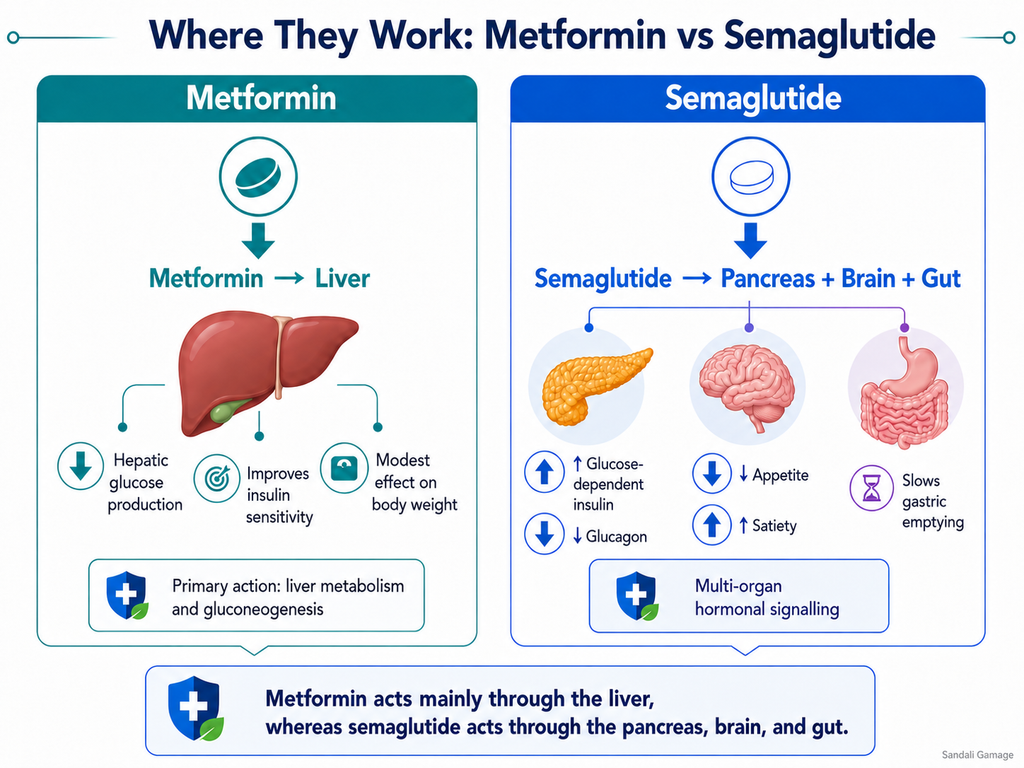
Metformin represents classical small-molecule pharmacology.
Semaglutide represents modern receptor pharmacology, peptide engineering, molecular modification and advanced drug-delivery technology.
Approximately six decades separate the introduction of metformin into diabetes practice and the arrival of oral semaglutide.
The contrast is striking:
Metformin:
small molecule → metabolic modulation → primarily reduced liver glucose production
Semaglutide:
engineered peptide → specific receptor activation → pancreatic + gastrointestinal + central nervous system effects
From a pharmaceutical-science perspective, this is unquestionably a major technological evolution.
However, it would be incorrect to describe semaglutide as simply “the new generation of metformin.”
It is not metformin 2.0.
It belongs to a completely different pharmacological class.
A useful analogy is that a modern electric vehicle and a traditional fuel-powered vehicle may represent different generations of technology, but one is not merely an upgraded version of the engine in the other. They operate on fundamentally different principles.
Similarly, semaglutide represents an expansion of our therapeutic possibilities rather than the automatic retirement of metformin.
Newer Does Not Automatically Mean Safer or Better for Everyone
Semaglutide’s effectiveness must be balanced against its adverse-effect profile, cost, availability and the individual patient’s medical condition.
The most common adverse effects are gastrointestinal, including nausea, vomiting, diarrhoea, abdominal discomfort and constipation. These effects are particularly common during dose escalation.
Semaglutide also requires consideration of gallbladder disease, pancreatitis, dehydration, renal complications related to severe gastrointestinal fluid loss, and diabetic retinopathy complications in some patients experiencing rapid improvement in glycaemic control. Product labelling also contains specific precautions and contraindications that must be reviewed before treatment.
Metformin’s most common adverse effects are also gastrointestinal, particularly diarrhoea, abdominal discomfort and bloating. Long-term therapy may contribute to vitamin B12 deficiency.
Metformin is excreted through the kidneys. Current recommendations therefore require assessment of renal function, and its use becomes inappropriate in severe renal impairment because accumulation can increase the risk of the rare but serious complication of lactic acidosis.
Neither medicine should therefore be selected solely according to popularity or expected weight loss.
The Most Important Question Is Not “Which Drug Is Better?”
The development of semaglutide demonstrates just how far pharmaceutical science has advanced since metformin entered clinical use.
Metformin transformed type 2 diabetes management by providing an effective, inexpensive and durable way to reduce excessive glucose production without routinely causing hypoglycaemia or weight gain.
Semaglutide introduced a different therapeutic concept: rather than simply modifying glucose metabolism, it mimics an endogenous hormonal signalling system and simultaneously influences insulin secretion, glucagon release, appetite, food intake and body weight.
For weight reduction, semaglutide clearly produces substantially greater average effects than metformin.
For glucose lowering, semaglutide is among today’s highest-efficacy non-insulin medicines.
But these observations do not mean that every person with type 2 diabetes should stop metformin and start semaglutide.
The most appropriate treatment depends on glycaemic status, body weight, cardiovascular and kidney disease, other medical conditions, adverse-effect risk, affordability, availability, patient preference and treatment goals.
Indeed, for many individuals, the appropriate therapeutic strategy may involve metformin and semaglutide together, rather than choosing one against the other.
A Pharmacist’s Perspective
Perhaps the most important lesson from the metformin–semaglutide comparison is how our understanding of medicines has evolved.
In 1957, metformin demonstrated that manipulating cellular metabolism could provide a practical oral treatment for type 2 diabetes.
More than six decades later, semaglutide demonstrates that scientists can redesign a naturally occurring peptide hormone, protect it from enzymatic destruction, prolong its activity through albumin binding and—even more remarkably—formulate such a peptide into an orally administered medicine.
That is a genuine pharmaceutical advancement.
But pharmaceutical progress should never be interpreted simply as:
old drug = inferior; new drug = superior.
The real advancement is that clinicians now have more precisely targeted therapeutic choices.
Metformin remains one of the most important medicines in diabetes care. Semaglutide represents a powerful additional tool, particularly when substantial glucose lowering, weight reduction and certain cardiometabolic benefits are important treatment objectives.
Ultimately, good pharmacotherapy is not about selecting the newest medicine.
It is about selecting the right medicine, at the right dose, for the right patient, for the right clinical objective.
Important note
This article is intended for health education and should not be interpreted as individual medical advice. Semaglutide and metformin are prescription medicines. Decisions regarding initiation, discontinuation, dose adjustment or use specifically for weight management should be made after assessment by an appropriately qualified healthcare professional. The approved indications, formulations and availability of semaglutide may differ between countries.
Selected References
- Bailey CJ. Metformin: historical overview. Diabetologia. 2017;60:1566–1576.
- Lau J, Bloch P, Schäffer L, et al. Discovery of the Once-Weekly Glucagon-Like Peptide-1 (GLP-1) Analogue Semaglutide. Journal of Medicinal Chemistry. 2015;58:7370–7380.
- Rena G, Hardie DG, Pearson ER. The mechanisms of action of metformin. Diabetologia. 2017.
- Solis-Herrera C, Kane MP, Triplitt C. Current Understanding of SNAC as an Absorption Enhancer: The Oral Semaglutide Experience. Clinical Diabetes. 2024;42:74–86.
- American Diabetes Association Professional Practice Committee. Pharmacologic Approaches to Glycemic Treatment: Standards of Care in Diabetes—2026. Diabetes Care. 2026;49(Suppl 1).
- American Diabetes Association Professional Practice Committee. Obesity and Weight Management for the Prevention and Treatment of Diabetes: Standards of Care in Diabetes—2026. Diabetes Care. 2026;49(Suppl 1).
- Davies M, Færch L, Jeppesen OK, et al. Semaglutide 2.4 mg once a week in adults with overweight or obesity and type 2 diabetes: STEP 2. Lancet. 2021.
- Wharton S, Lingvay I, Bogdanski P, et al. Oral Semaglutide at a Dose of 25 mg in Adults with Overweight or Obesity. New England Journal of Medicine. 2025;393:1077–1087.
- Sri Lanka College of Endocrinologists. Clinical Practice Guideline: Diabetes 2025. Sri Lanka Journal of Diabetes Endocrinology and Metabolism. 2025;16(2):3–173.
Pingback: From Metformin to Semaglutide to Orforglipron: Are Diabetes Medicines Becoming More Than Diabetes Drugs? August | 2026