

By a PhD student in molecular biology
My grandmother had a rule, delivered with the confidence of someone who had never once been contradicted at the dinner table: “Don’t pull that gray hair out. Two more will grow in its place. Seven will come to its funeral.”
I believed her for most of my childhood. I believed her through my teens, when I first spotted a single silver strand above my ear and stared at it in the bathroom mirror like it was a tiny betrayal. And I will admit, with the embarrassment of someone who now spends their days studying DNA damage and mass-spectrometry data, that I still hesitated before plucking it a few years ago.
So let me do what a lab rat does best: take the myth apart, look at the pieces under the scope, and see what actually holds up. The short version is that plucking a gray hair does not make more gray hairs grow. The longer version is far more interesting, because it takes us into stem cells, oxidative chemistry, mitochondria, and the proteins that decide the color of your head.
First, what is a gray hair, really?
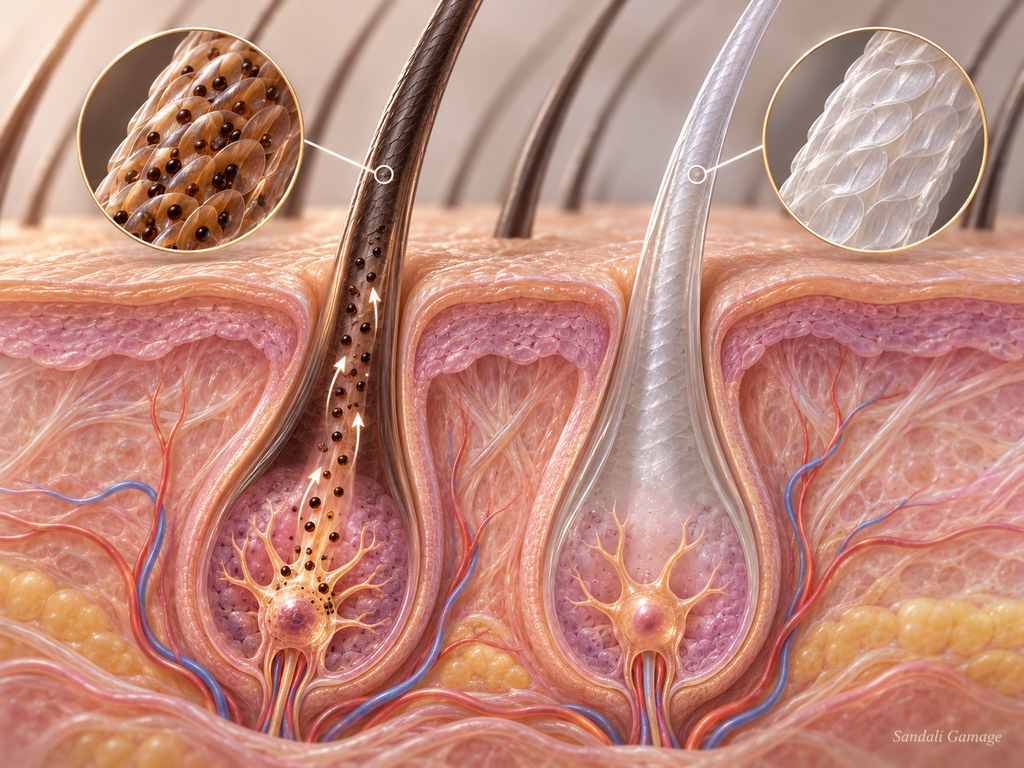
Here is the first surprise: gray and white hairs are not “gray” or “white” in the way you might think. There is no gray pigment. A hair shaft is made almost entirely of keratin proteins, which are naturally a pale, translucent, yellowish-white. Color comes from melanin, the pigment produced by specialized cells called melanocytes that sit in the hair bulb at the base of the follicle.
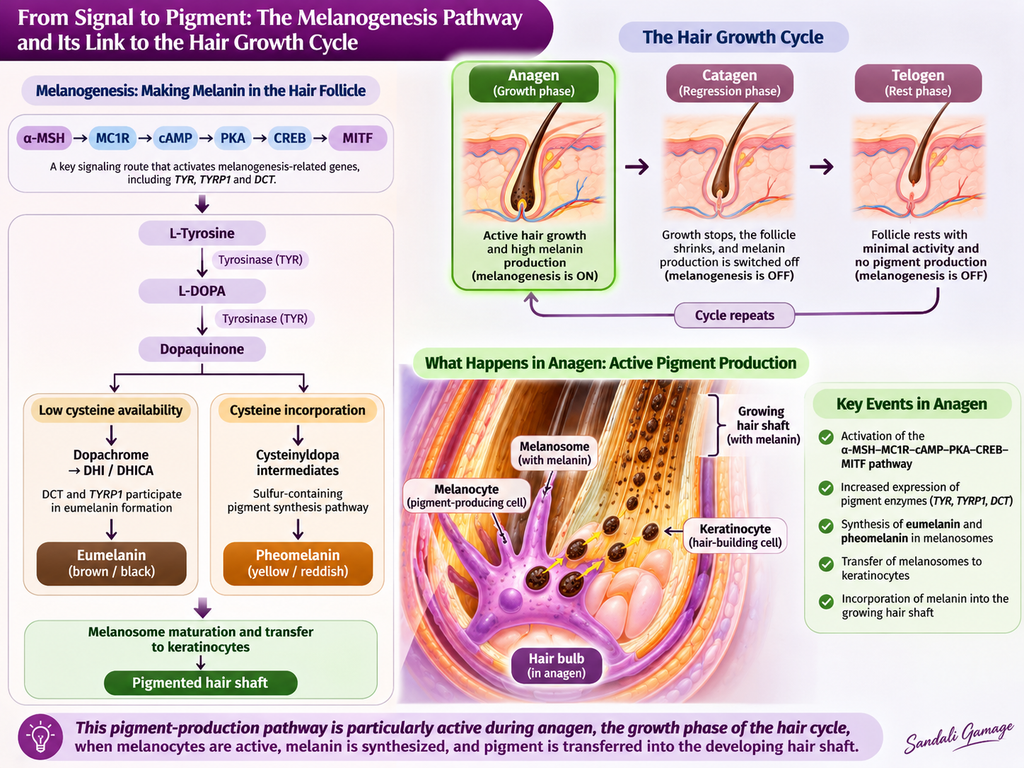
Melanocytes make melanin inside little organelles called melanosomes, using a small enzymatic assembly line. The star of that line is tyrosinase (TYR), which converts the amino acid tyrosine into the precursors of pigment. Supporting players include TYRP1, DCT (dopachrome tautomerase), and structural proteins like PMEL that build the scaffold inside the melanosome. The finished melanosomes are then handed off to the neighboring keratinocytes, the cells that build the hair shaft, so that pigment is packed into the growing fiber like dye soaking into thread.
So a gray hair is simply a hair that was built without enough pigment loaded in. A white hair has essentially none. The “gray” you perceive in a head of hair is mostly a visual average of pigmented and unpigmented strands sitting side by side, and the light-scattering properties of the bare keratin.
The real culprit: a stem cell problem
If a hair lacks pigment, the question becomes: where did the pigment cells go?
Every hair follicle is a tiny self-contained mini-organ that cycles through growth (anagen), regression (catagen), and rest (telogen). Tucked into a region of the follicle called the bulge and sub-bulge is a reserve population of melanocyte stem cells (McSCs). Each time the follicle begins a new growth phase, some of these stem cells are called up, divide, and their daughter cells migrate down into the bulb, mature into pigment-producing melanocytes, and supply color to the new hair. When the cycle ends, a fresh reserve is meant to be left behind for next time.
Graying, at its core, is what happens when that reserve runs low or stops working properly. Several lines of research point to the same story:
- In mouse work from the Nishimura lab, published in Nature in 2005, McSCs were shown to be lost with age and when key survival and differentiation programs, including signaling through the transcription factor MITF, were disturbed. Once the stem cell pool is exhausted, new hairs emerge colorless.
- Work from the Hsu lab at Harvard, published in Nature in 2020, showed in mice that stress can drive the sympathetic nervous system to release norepinephrine near the follicle. That signal pushed McSCs to over-activate, differentiate prematurely, and wipe themselves out. The reserve was spent too quickly, and the hair turned white.
- A later study from the same group, in Nature in 2023, suggested McSCs are more dynamic than we assumed, shuttling between niches in the follicle as the hair cycle turns, and that graying may involve stem cells getting stuck in the wrong spot and failing to re-differentiate into pigment cells.
Notice what these papers have in common. The decisive events happen inside the individual follicle, in its own stem cell niche. That is the key to understanding why the plucking myth cannot work.
The chemistry of fading color
There is a second layer to the story, and as someone who spends her days thinking about DNA lesions and protein modifications, this is the part that I find most elegant.
Melanin production is chemically messy. Making pigment generates reactive oxygen species (ROS), including hydrogen peroxide, as a byproduct of tyrosinase activity. Young melanocytes have a robust antioxidant toolkit to cope with this, including the enzyme catalase and the repair enzymes methionine sulfoxide reductases (MSRs), which fix oxidized methionine residues in proteins.
With age, those defenses seem to weaken. A classic 2009 study in FASEB Journal by Wood and colleagues found that gray and white hair follicles accumulate hydrogen peroxide in millimolar amounts, along with reduced catalase and MSR activity. In effect, the follicle bleaches itself from within, and the oxidative damage also impairs tyrosinase itself. Pigment production falters, and melanocytes become vulnerable to damage to their DNA and proteins.
In other words, graying is a combination of stem cell depletion (you run out of cells that can make pigment) and oxidative and mitochondrial stress (the cells that remain struggle to do their job).
What proteomics adds to the picture
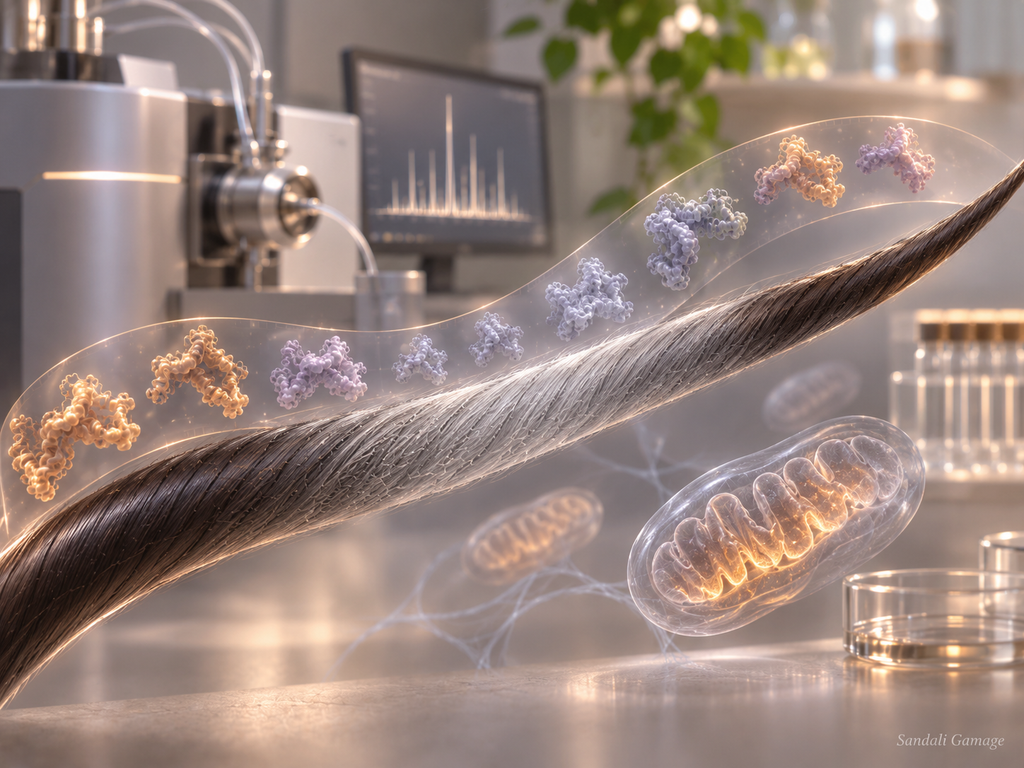
My corner of the field, proteomics, has started to contribute to this puzzle in a delightfully tangible way. Hair is a kind of molecular tape recorder: it grows at roughly one centimeter per month, and the proteins laid down in each segment reflect the cellular conditions at the time that segment was made.
A 2021 study in eLife from the Picard lab at Columbia University used this property cleverly. They analyzed individual hairs segment by segment, tracking the transition from pigmented to unpigmented stretches along a single strand. Their proteomic profiling found that hundreds of proteins differed in abundance between gray and pigmented segments, and the changes pointed strongly toward altered mitochondrial function and metabolism. Even more striking, a handful of hairs showed temporary reversal of graying, and those reversals appeared to line up with periods when the person’s life stress had eased.
I want to be careful here: this was a small study, on a limited number of people, and it describes association, not proof of cause. But it reinforces something important. Graying is not a one-way, irreversible event at the molecular level. It is a dynamic state that reflects cell biology, which can in principle shift. And crucially for our question, the reversal happened in individual strands, which again underlines that each follicle follows its own molecular schedule.
So why can’t plucking spread the gray?
Let’s now put the pieces together and test the myth directly.
1. Each follicle is its own independent unit. The color of a hair is decided by the McSCs and melanocytes living in that follicle. There is no known mechanism by which the pigment status of one follicle is transmitted to its neighbor like a contagion. Gray is not a virus, a toxin, or a signal that gets released when you tug a strand out.
2. Plucking removes the shaft, not the stem cell reserve. When you pull a hair, you extract the fiber and often the lower part of the follicle’s bulb. But the bulge, where the McSCs and the epithelial stem cells live, is higher up and generally stays in place. The follicle then re-enters the growth cycle and makes a new hair. Whatever pigment capacity that follicle still has is what the new hair gets. If the McSC pool was already depleted, the replacement is gray, but that is because the follicle was already gray, not because you plucked it. If it still has a viable pool, the new hair can come in pigmented, at least for a while.
3. Hairs don’t “multiply” when plucked. The myth that two grow back relies on the idea that a follicle can branch. It cannot. One follicle produces one hair at a time. Occasionally you may see several hairs emerging from a single pore, which is a normal anatomical arrangement in some body regions, but plucking does not create that.
There is one nuance I find genuinely interesting, and I do not want to hide it just to make my argument tidier. In a 2015 Cell paper, Cheng-Ming Chuong’s lab at USC showed in mice that plucking a large number of hairs in a defined area can trigger neighboring, unplucked follicles to regenerate, through a kind of “quorum sensing” involving inflammatory signals such as CCL2 and TNF-alpha and recruited immune cells. So plucking can influence neighboring follicles’ timing, nudging them toward a new growth phase. But this is about cycling, not about color. Nothing in that work suggests plucked follicles transmit a graying signal to their neighbors. It was also in mice, and in a context of mass plucking, not of the lone silver strand in your fringe.
And to be fair and honest: I am not aware of any rigorous human trial that has directly tested whether plucking gray hairs changes how many gray hairs you later develop. The absence of such a study does not mean the myth might be true. It means the myth lacks a proposed mechanism and lacks supporting evidence, while the biology we do understand argues firmly against it.
So where does the myth come from?
Folk beliefs rarely come from nowhere. I suspect a few very human things are at work.
- Timing and coincidence. Graying is progressive. If you pluck one gray hair today, more will appear over the following months and years, simply because more follicles are reaching the end of their McSC supply on their own schedule. Our brains love to link events in sequence, and “I pulled one, then more appeared” feels like cause and effect.
- Attention bias. Once you have pulled a gray hair, you start scanning your head and the mirror for others. You notice what you are looking for. The grays were probably there; you just were not looking.
- Texture. Gray and white hairs often feel coarser, wirier, and less manageable, and they tend to stand out from the rest. A single stubborn silver strand sticking up looks more noticeable than the dozens of dark ones lying flat.
- Regional clustering. Follicles in the same area of the scalp tend to age on similar timelines, shaped by shared genetics and local environment. Grays often appear in patches, such as the temples, which can make a plucked area look like it “filled in.”
- The “two grow back” folklore. This sounds suspiciously like the broader myth that shaving makes hair grow back thicker, which has the same cause: a blunt-tipped regrowing hair feels coarser than a tapered, uncut one. People’s lived impressions often get mistaken for biology.
Genetics, of course, sets the overall tempo. Large-scale genetic studies, including a 2016 genome-wide analysis in Nature Communications by Adhikari and colleagues, identified variants near the gene IRF4, which regulates pigment-related programs, as being associated with hair graying. Ancestry influences onset, with graying beginning on average earlier in people of European descent than in people of African descent, with Asian populations in between. Smoking, chronic stress, certain nutritional deficiencies such as low vitamin B12, and autoimmune conditions like vitiligo or thyroid disease have also been linked to earlier graying. None of these has anything to do with how many strands you have pulled.
So should you pluck or not?
Here is where I will gently wave away my own pedantry and speak as a person rather than a data table. You are allowed to pluck a gray hair. It will not cause an invasion. But I would not recommend it as a long-term habit, and for reasons that have nothing to do with color.
- Repeated plucking can damage the follicle. Chronic trauma may lead to inflammation, folliculitis, ingrown hairs, or in some cases scarring, and in the extreme, a permanently dormant follicle and thinning in that spot. This is the same mechanism behind traction alopecia and trichotillomania-related damage.
- It does not fix the underlying issue. The follicle is gray because its pigment reserve is limited. Plucking cannot restore the stem cells, so it is a short-lived fix at best.
- Safer cosmetic options exist. If the look bothers you, trimming the strand close to the scalp, coloring, or simply learning to love the silver are all lower-risk ways to deal with it.
And if you started graying unusually young, say in your teens or twenties, or you notice it alongside other symptoms like fatigue, unexplained patchy skin color loss, or hair loss, it is worth mentioning to a doctor. Occasionally early graying is a flag for thyroid issues, vitamin deficiencies, or autoimmune processes, and those are far more worth your attention than the strand itself.
What I told my grandmother
I did eventually tell my grandmother what I do for a living, and what I had learned about her famous rule. She listened patiently, nodded in the way people nod when they plan to ignore you, and said, “Well, that’s all very nice. But I pulled out one gray hair at forty and look at me now.”
She was, of course, completely right, and that is the beauty of the myth. She pulled one at forty, and by seventy her head was entirely silver. The timeline fits. The causation does not. The stem cells in each of her follicles ran down on their own genetic and biological schedule, not because of anything she did at her mirror.
So here is the takeaway I would offer anyone standing at a mirror with tweezers and a guilty conscience. Gray hair is not a plague that spreads through plucking. It is the quiet, individual, follicle-by-follicle story of stem cells running low, oxidative stress building up, and mitochondria slowing down. Each strand tells its own molecular tale. Pulling one out edits that tale no more than tearing a page from a novel changes how the other chapters end.
Your silver hairs are coming, if they are not already here. Pluck or do not pluck, but know that you are not making it worse, and that, in cellular terms, you are carrying a small and rather beautiful record of time in your hair.
Reference
- Nishimura EK, et al. Regulation of melanocyte stem cells by Bcl2 and Mitf. Nature, 2005.
- Wood JM, et al. Senile hair graying: H2O2-mediated oxidative stress affects human hair color by blunting methionine sulfoxide repair. FASEB J, 2009.
- Zhang B, et al. Hyperactivation of sympathetic nerves drives depletion of melanocyte stem cells. Nature, 2020.
- Rosenberg AM, et al. Quantitative mapping of human hair greying and reversal in relation to life stress. eLife, 2021.
- Sun Q, et al. Dedifferentiation maintains melanocyte stem cells in a dynamic niche. Nature, 2023.
- Chen CC, et al. Organ-level quorum sensing directs regeneration in hair stem cell populations. Cell, 2015.
- Adhikari K, et al. A genome-wide association scan in admixed Latin Americans identifies loci influencing facial and scalp hair features. Nature Communications, 2016.